KiwiSaver Recommendation Engine
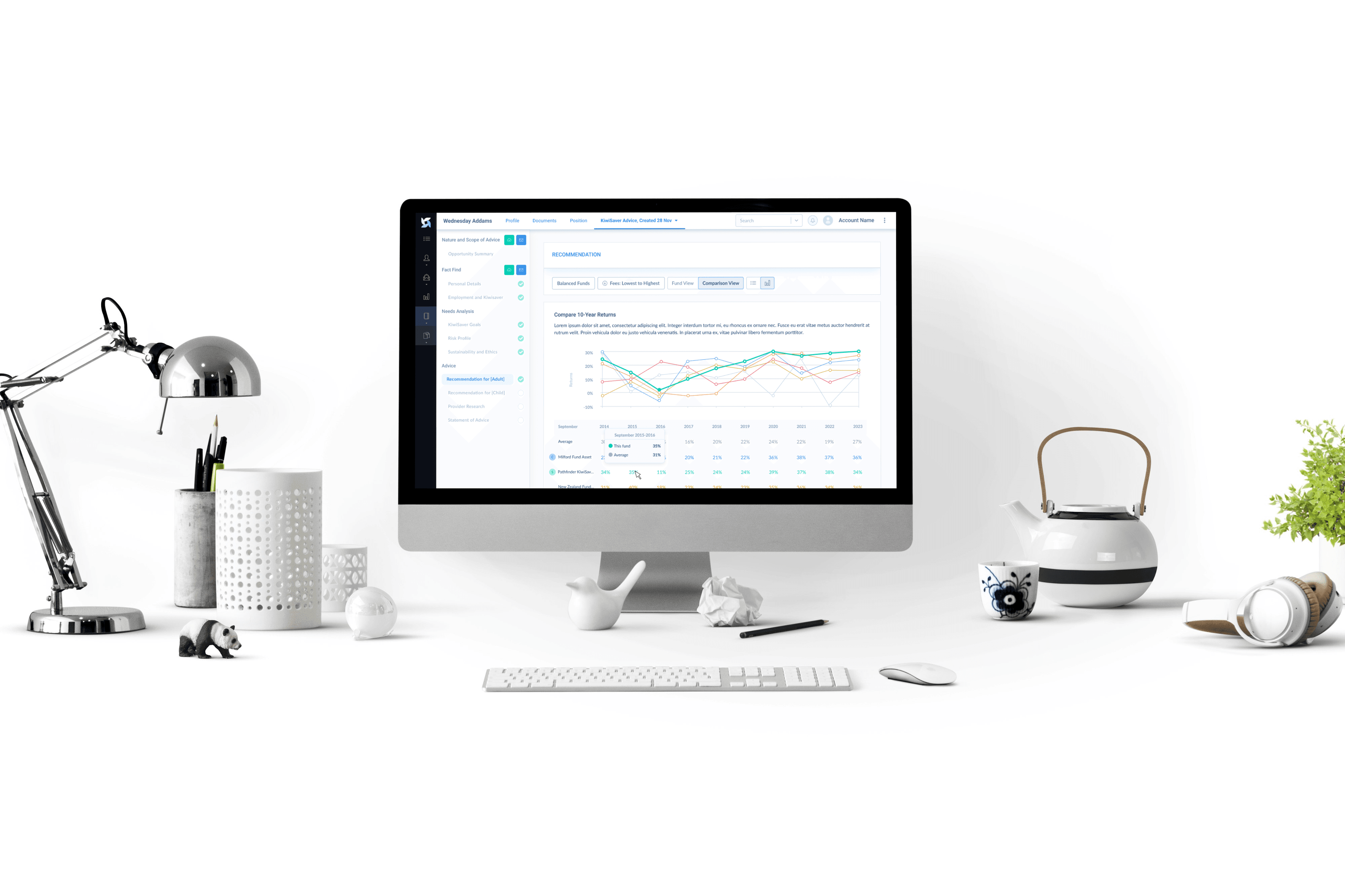
Overview
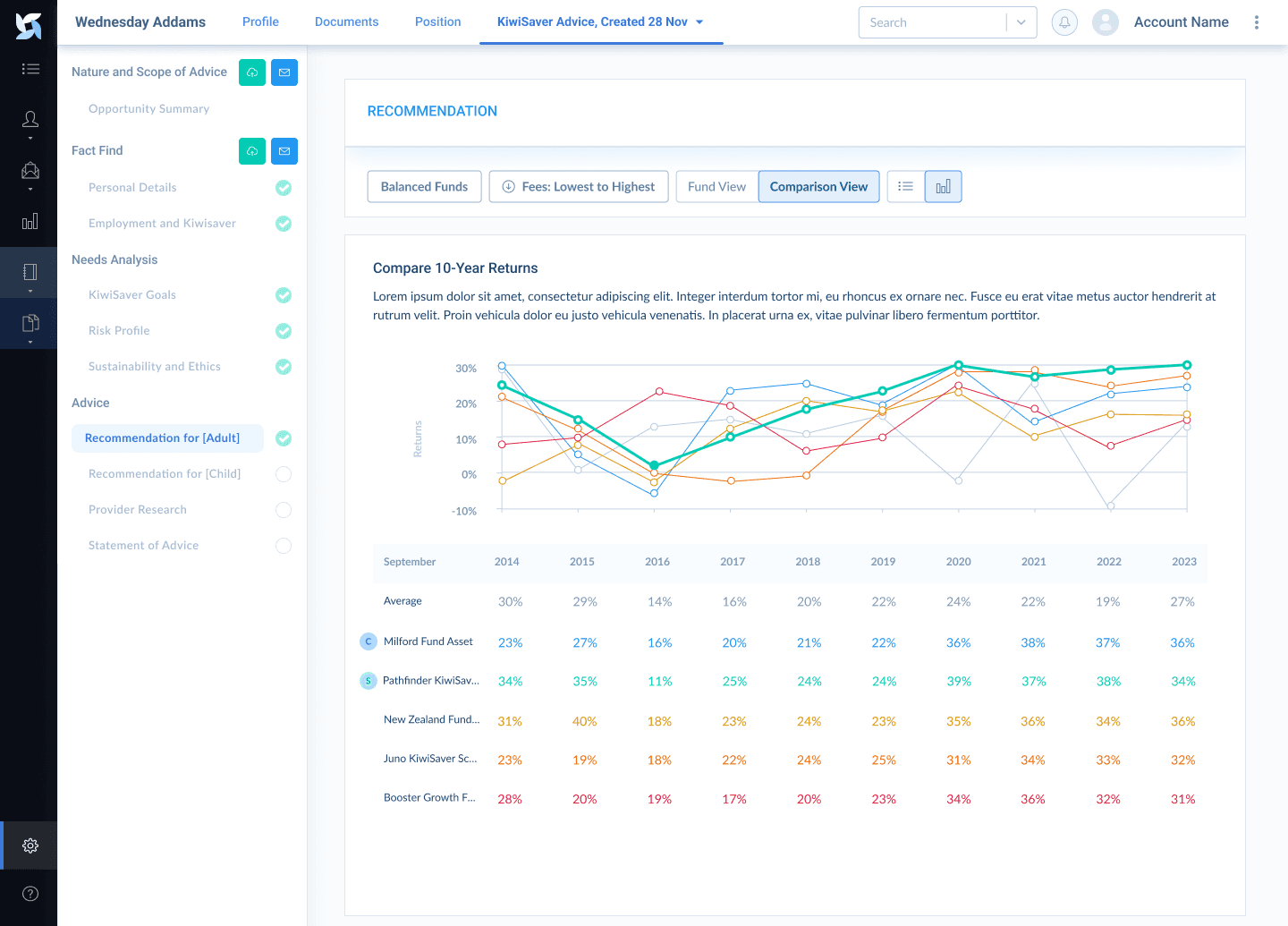
Trail is a comprehensive SaaS CRM and advice platform for mortgage and insurance advisers in New Zealand. In a highly regulated industry, Trail automates the "heavy lifting" of compliance, allowing advisers to focus on providing expert financial guidance. Traditionally, KiwiSaver support in Trail was "bare-bones" - it captured data but didn't provide actual advice. This case study focuses on the KiwiSaver Recommendation Engine (Part 3 - see diagram below), a pivotal upgrade designed to move the platform from a simple data-entry tool to a sophisticated, all-in-one advice powerhouse.
Role
Lead UX Designer
Tools
Figma, FigJam, ClickUp
Timeline
12 weeks (discovery to release)
Stakeholders
Product Owner, Technical Lead, Financial Compliance Officers
Click to expand
What we set out to solve
Inefficiency
Manual data entry across multiple tools was time-consuming and prone to human error.
A Disjointed Client Experience
Recommendations felt disconnected from the initial data-gathering phase.
Lost Sales Opportunity
Prospective clients were hesitant to switch to Trail because they didn't want to manage two separate software products to provide a single piece of advice.
The Problem
While Trail successfully captured client data (via Part 1: Fact Find & Risk Profiling), the actual advice loop remained unclosed. To provide a recommendation, advisers were forced into constant context switching, leaving the platform to use external calculators, spreadsheets, or competing software like Omnimax to research funds and generate projections. This fragmented workflow was more than just a nuisance; it was a business risk. It led to; inefficiency, a disjointed client experience, lost sales opportunities.
The Solution
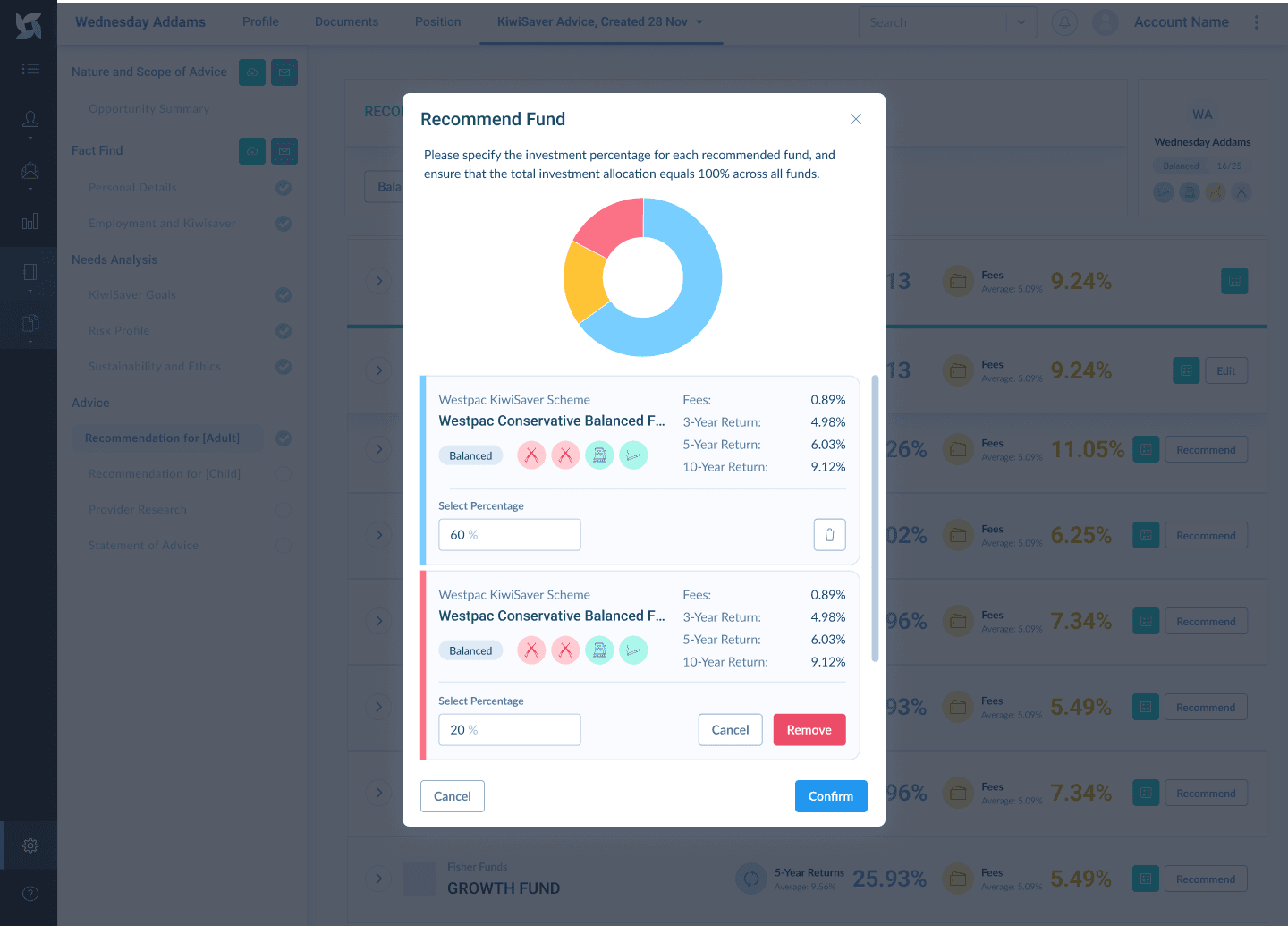
We designed an end-to-end engine that reduced task time by 66%. By integrating live data from 100+ providers, I eliminated the "Research Rabbit Hole" through a side-by-side comparison tool and simplified complex auditing with visual 10-year projections. I also pioneered a Household-First Architecture, enabling advisers to manage parents and dependents simultaneously, and replaced static spreadsheets with an interactive "Donut Chart" for real-time portfolio balancing.
Discovery
User Journey
Current User Journey (End-to-End)
To design an effective recommendation engine, I first had to map out the existing end-to-end journey of a KiwiSaver adviser. This process revealed that while data collection was digital, the critical middle steps — analysis and recommendation — often happened in a vacuum outside of the CRM. The resulting journey map identifies five key stages where design could bridge the gap between simple data entry and professional financial advice:
Visualising the end-to-end advice loop helped us identify the ‘Fragmented Gap’ where advisers were losing the most of their time to manual context-switching. · Click to expand
Identifying Friction
Competitive Research
I looked into how tools like Omnimax handled fund comparisons. While they were data-heavy, the UI was often dated and clunky. My goal was to take their level of data depth and wrap it in a modern, streamlined UX that felt like a natural extension of the Trail ecosystem.
Stakeholder Insight
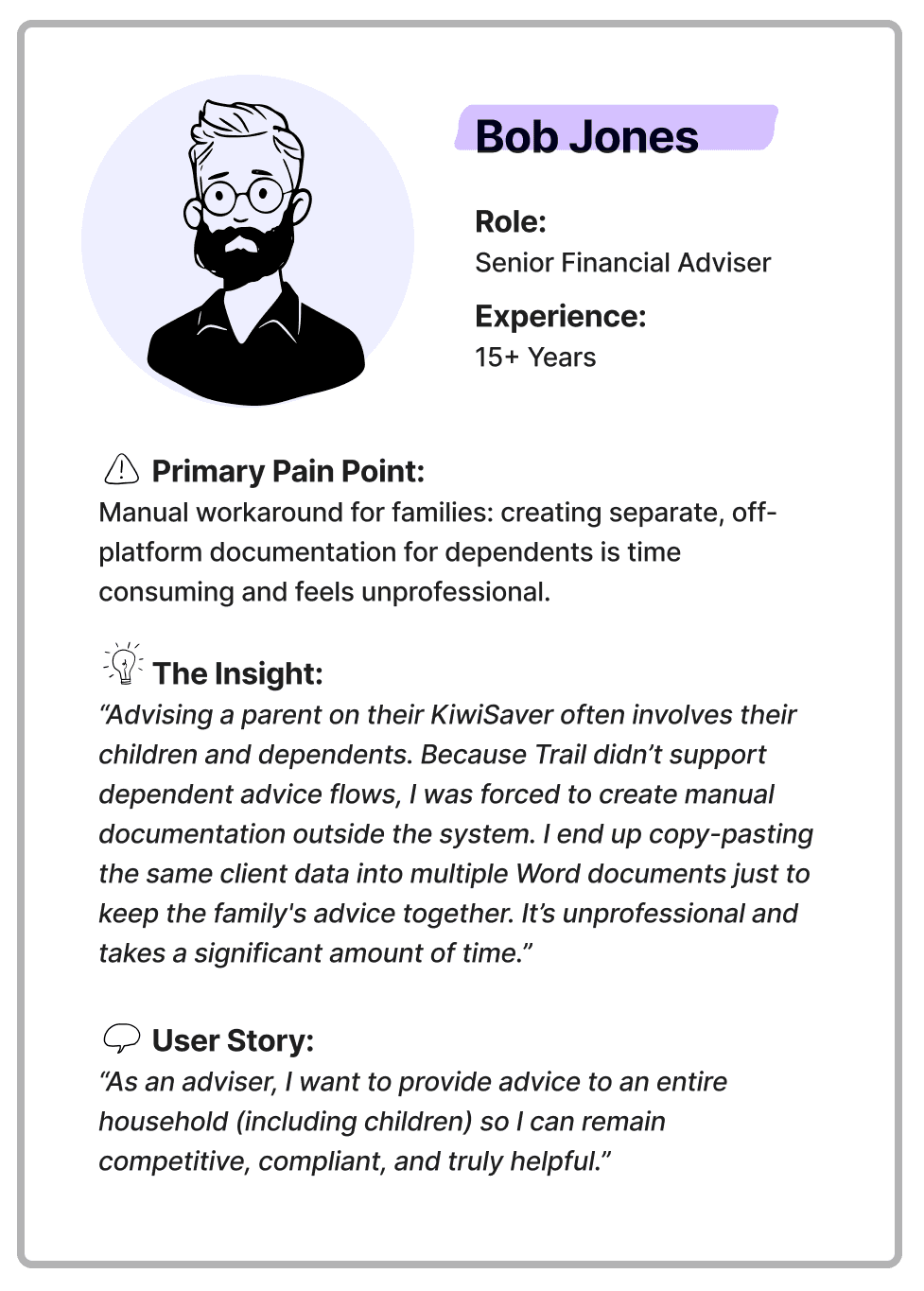
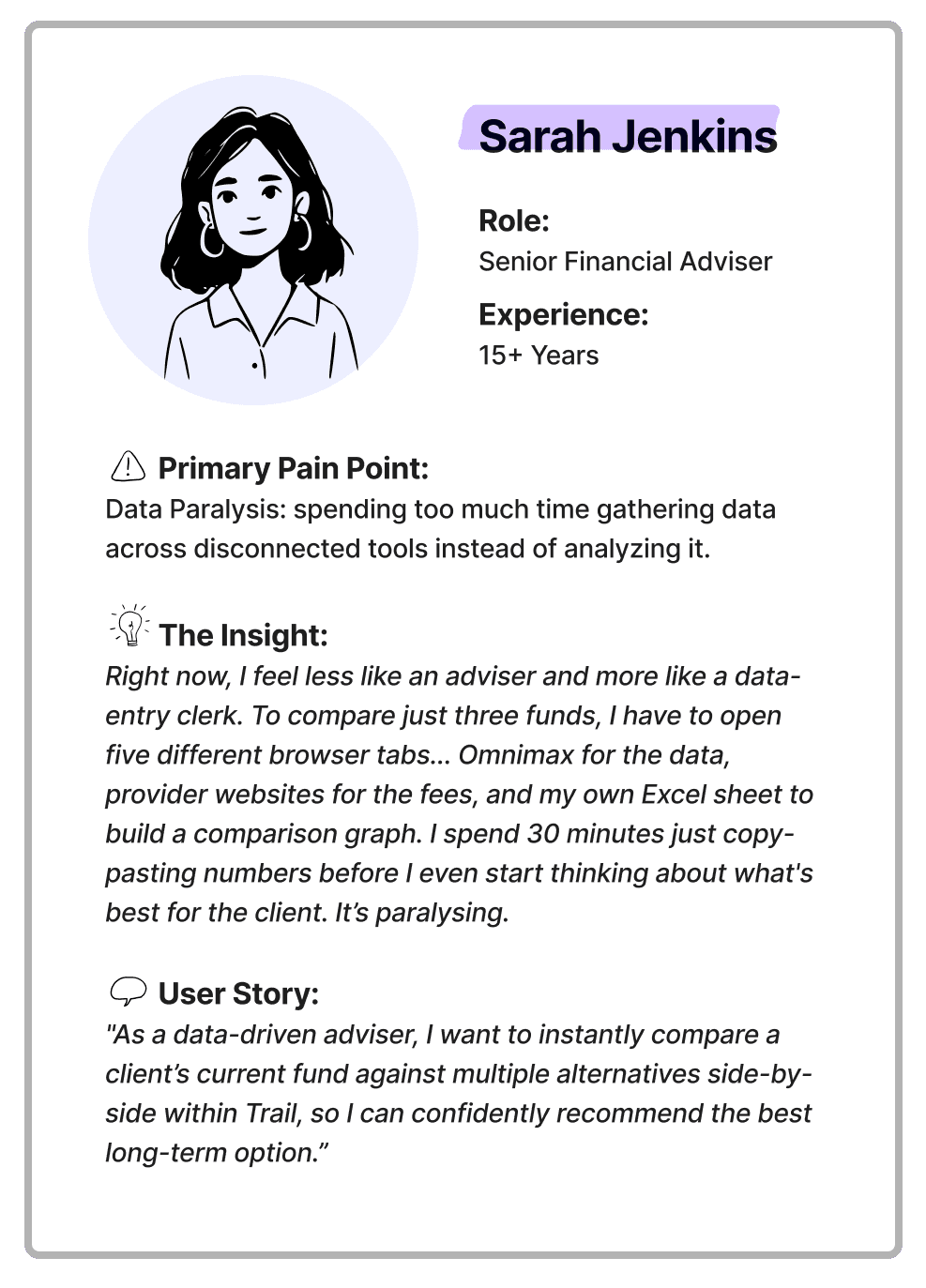
To understand why the existing KiwiSaver process felt "incomplete," I conducted deep-dive interviews with several senior advisers. Two key stakeholders provided the critical insights that redefined our product roadmap. Bob highlighted a logical flaw in the existing system: financial advice in the real world is familial, not just individual. Meanwhile, Sarah pointed out the grueling manual labor required to actually find a fund.
Defining Success
Acceptance Criteria
Based on the research, I worked with the Product Owner to define the must-haves for this project. These weren't just features, they were the benchmarks for a successful user experience.
Click to expand
Ideation
User Journey
Mapping the New Advice Journey
To transition the adviser from a "capture" mindset to a strategic "advice" mindset, I mapped a logic flow that simultaneously closed Bob's "Household Gap" and filled Sarah's "Research Rabbit Hole." I architected a multi-entity workflow that allowed for dependent "branches," ensuring advice for children remained within the parent's context to eliminate Bob's manual workarounds, while also designing an integrated data engine to pull live fund metrics directly into Trail, solving Sarah's need for efficiency by killing off context-switching. This logic flow explicitly balanced system automation; offloading the repetitive data-entry tasks that paralysed Sarah, and allowing advisers like Bob to focus on high-value family goals rather than juggling multiple screens.
Click to expand
Design Opportunities
Technical Constraints
Collaborating early with the engineering team (specifically our Technical Lead) was crucial. We hit a snag: not all KiwiSaver funds have 10 years of data. ⦁ The Problem: A blank graph looks like a broken product. ⦁ The Solution: I designed a "Graceful Degradation" state. If a fund was newer than 10 years, the UI would clearly display "N/A" with a tooltip explanation rather than an empty line. This ensured the adviser looked competent and the data remained transparent.
Low Fidelity Experimentation
Before jumping into high-fidelity pixels, I used wireframes to test the "Information Density." I had to decide: How much data is too much? I experimented with "Progressive Disclosure"… hiding deep technical fund details behind a "View More" accordion to keep the primary comparison screen clean and focused.
Low fidelity experimentation · Click to expand
Design
Translating Complexity into Clarity
The KiwiSaver Recommendation Engine
With the logic validated, the goal of the UI was to create a "glass-box" experience, where the adviser and the client could see exactly how a recommendation was formed. I focused on three core pillars: Visual Storytelling, Interactive Allocation, and Guided Customisation.
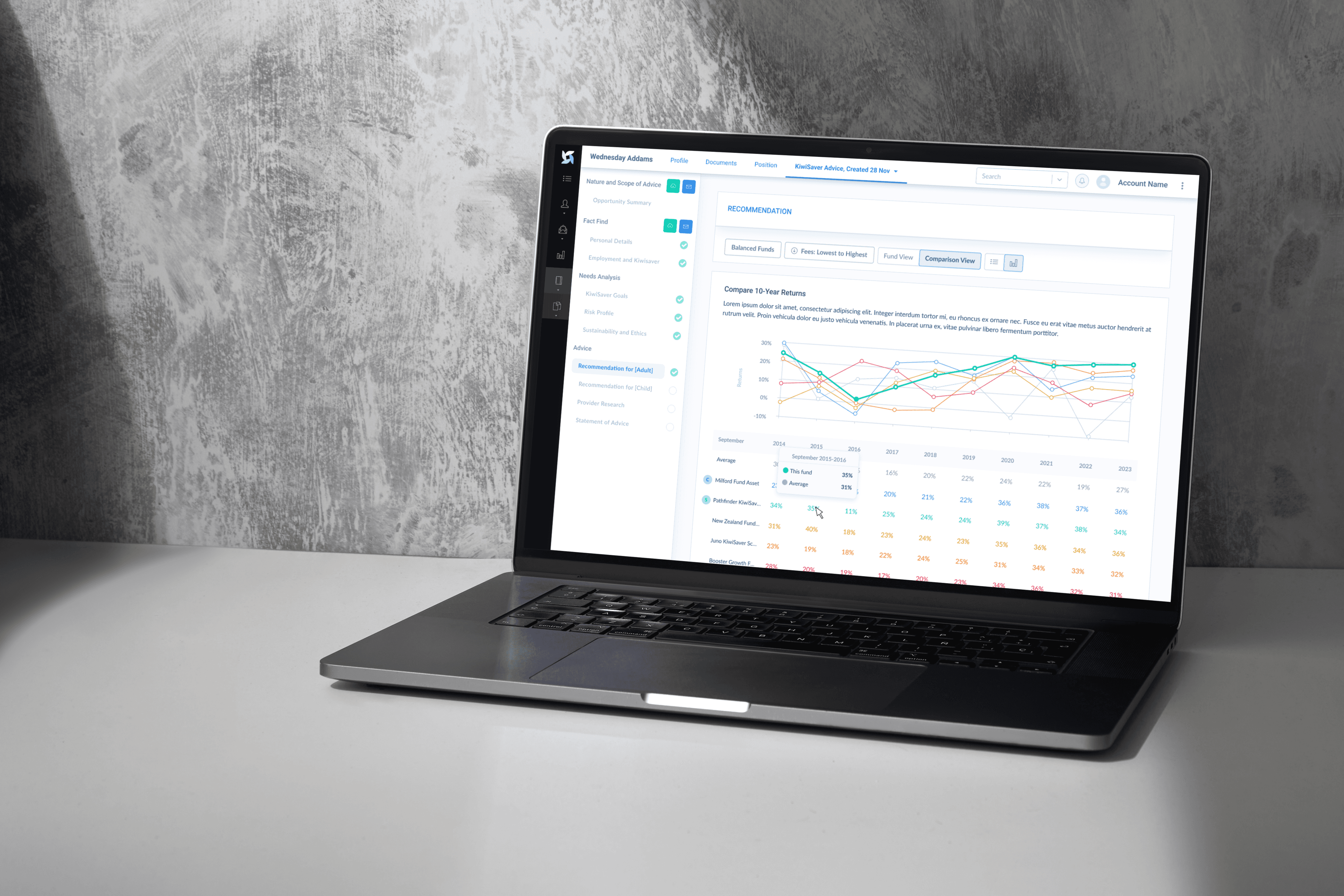
DATA AT A GLANCE
The Fund Comparison Tool
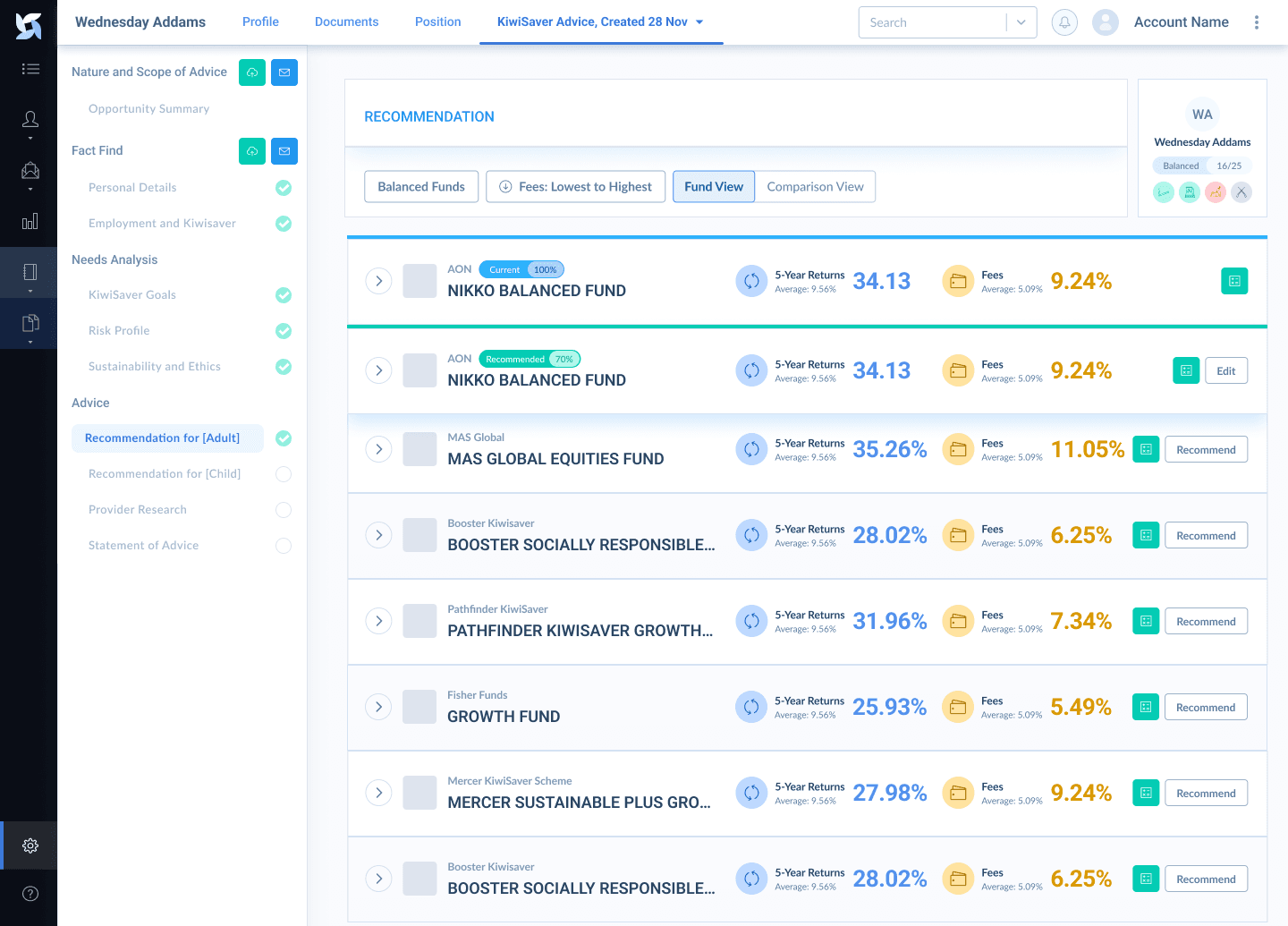
I implemented circular progress gauges for 5-Year Returns and Fees, letting advisers instantly see if a fund is outperforming the market. The Accordion Detail view manages information density — clicking "Details" reveals asset mix charts, 10-year projections, and key documents.
INTERACTIVE ALLOCATION
The Donut Chart
I reduced the cognitive load of portfolio balancing by designing a real-time interactive donut chart. As the adviser types a percentage, the donut segments update instantly, ensuring a 100% allocation across risk levels and minimising manual calculation errors during live client meetings.
SOLVING THE HOUSEHOLD GAP
Sidebar Navigation
I streamlined the multi-entity workflow through a persistent Household Navigation Toggle in the sidebar. Advisers can switch between family members with a single click, building a comprehensive household strategy without losing progress or context.
Prototype
Try the Interactive Prototype
Walk through the recommendation engine yourself. The experience adapts to your screen — explore the desktop build on a larger display, or the mobile build on your phone.
Final Designs
Screen mockups
A selection of key screens from the final product design
Results
Business Impact & Results
By closing the “Advice Loop,” the new engine didn't just improve the UI... it drove measurable growth for the Trail platform.
65%
Reduction in advice preparation time
By integrating fund research and 10-year projections directly into the CRM, we transformed a fragmented 45-minute manual process into a 15-minute streamlined task.
30%
Increase in SOA generation
Providing a unified, household-level workflow empowered advisers to generate more advice for more family members in less time, directly increasing the volume of recommendations tracked within the platform.
40%
Growth in platform adoption
By closing the "Advice Loop" and eliminating the need for external spreadsheets, we successfully retained high-volume firms that previously relied on competing software for their research.
Reflection
Reflection
Learnings
Designing for the “Family Unit,” not just the User: The most significant breakthrough (The “Bob Jones” insight) came from realising that financial decisions aren't made in isolation. Designing for a household required a shift in data architecture, not just UI, proving that UX must influence the back-end logic to be truly effective.
Balance “Automation” with “Agency”: I learned that while advisers like Sarah wanted to escape the “data-entry clerk” role, they didn't want a “black box” solution. The UI needed to provide the math (Automation) but allow the adviser to own the narrative (Agency).
Compliance as a Creative Constraint: Initially, legal requirements felt like a barrier to clean design. However, by treating compliance as a “guardrail” (like the locked blocks in the editor), it actually became a feature that built trust and reduced user anxiety!
Next Steps
Mobile-First Mode: While the current engine is optimised for desktop, the next iteration would focus on a tablet or mobile optimised view. This would allow advisers to walk through the interactive 10-year projections and the donut chart side-by-side with a client in a casual setting.
AI-Powered Narrative Assistance: To further reduce Sarah's workload, I'd explore using LLMs to draft initial “Advice Reasoning” based on the selected fund's performance data, which the adviser could then refine and personalise.
Proactive Portfolio Monitoring: The next phase would move from “One-off Advice” to “Ongoing Care” implementing a system that alerts the adviser if a client's fund performance or risk profile drifts significantly from the original recommendation.